Chapter 6
Helping Someone with Anxiety or OCD
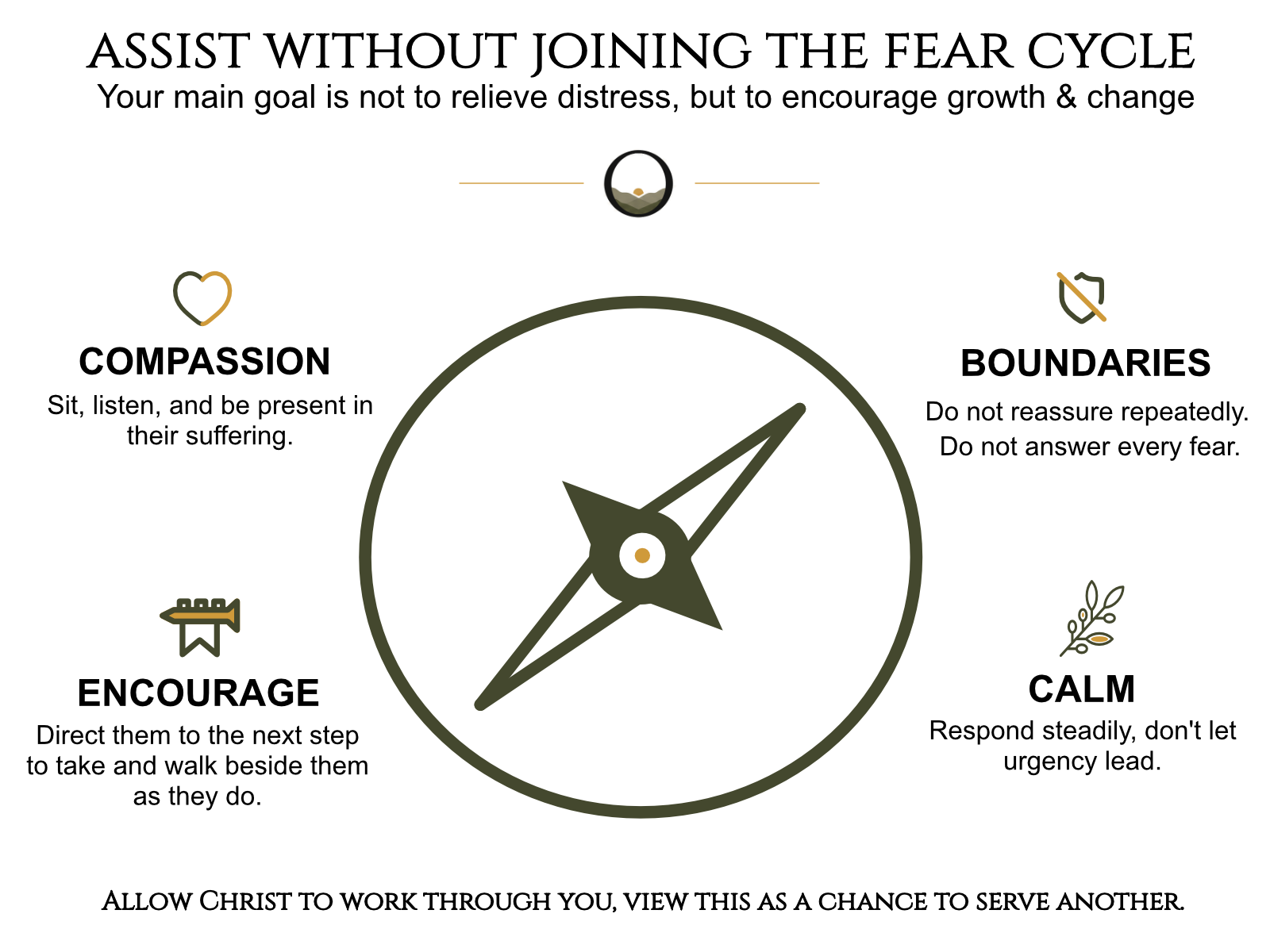
As a friend or loved one, learn how to offer compassion, maintain healthy boundaries, and offer encouragement that is healthy and helpful, without reinforcing unhealthy habits.

Does this feel familiar?
They repeatedly ask you, “Am I okay?”
You are frequently asked if a certain outcome is likely.
The conversation keeps returning to the same fear, even after it has been thoroughly discussed.
They seek constant reassurance from you & others.
You are asked to avoid all sorts of topics, locations, or activities so you don’t trigger more distress.
Main Guide
For Loved Ones
How to stay near someone who is struggling without trying to carry what only they—and ultimately God—are able to.

Everyone Has Learned the Choreography.
At some point, you may realize that the fear no longer belongs only to the person who is afraid.
Everyone knows the routine.
Someone asks whether the door is really locked.
You check.
Subjects get raised and you try to change the flow of discussion so it doesn’t cause distress.
Schedules get adjusted to avoid triggers.
A question gets answered once.
Then again.
Then in slightly different words.
Maybe you have learned which stores are easier, which roads create problems, which conversations should wait, which movies should be avoided, which subjects are likely to turn the evening into another long discussion.
No family meeting was ever held.
There was no conscious decision of: we are going to arrange our lives around this.
It simply just became the newest version of normal.
One accomadation made sense.
Then another.
Then another.
You saw someone you love hurting, and you did what loving people instinctively do.
You tried to help them feel better.
That matters.
Because the place to begin is not by accusing yourself of “enabling,” and certainly not by becoming suspicious of every compassionate thing you do for others.
But there is a question every person who loves someone deeply eventually has to face:
What do you do when loving them becomes unhelpful and unhealthy?
That is where this gets difficult.
When Their Distress Begins to Feel Like Your Emergency
One of the hardest moments come when you begin changing how you help someone.
They may not like it.
They may cry.
They may become frustrated.
They may say:
“You don't understand.”
“You used to help me.”
“Just one more time.”
Their distress starts to become your distress.
The tension becomes akward.
You feel guilty.
You need the evening restored.
You don’t wan’t to waste the rest of the day on this.
But Christian love asks something deeper of us than simply arranging every interaction around the fastest path to emotional relief.
Jesus Was Never Frantic Around Suffering
One of the remarkable things about Jesus is how fully present he could be with suffering without becoming controlled by its urgency.
He was not detached.
Jesus wept.
He reached out to those others avoided.
He noticed the suffering others walked by.
He was moved with compassion.
Jesus' compassion never required him to surrender wisdom.
He could love someone intensely without allowing the emotional demand to determine what he did.
That matters for Christ followers.
Christlike love is neither panic nor distance.
Love comes near.
Love listens.
Love grieves.
Love serves.
And it remains steadfast enough to seek another’s actual good.
There is another danger that arrives once a loved one learns about reassurance, avoidance, compulsions, and anxiety.
The whole relationship turns into a counseling session.
You begin watching for compulsions.
You begin listening for avoidance.
You evaluate every question they ask.
You track their growth.
Soon you become the observer and they the observed.
Both of you become exhausted.
You Are Allowed to Be a Loved One
You are allowed to remain:
Their husband.
Their wife.
Their dad.
Their mom.
Their brother.
Their sister.
Their friend.
Love them for who they are as someone made in God’s image.
Talk about something else.
Eat dinner.
Laugh.
Go somewhere.
Do a Bible study.
Watch the game.
Take the walk.
Ask what they think about something that has nothing to do with anxiety.
Their struggle is significant.
But it’s not the sum of who they are.
And it’s not the sum of who you are to each other.
An aspect of loving someone well is helping them remain connected to a life larger than fear.
You Can Act in Love and They May Still Feel Anxious
They might wish you had answered differently.
The conversation may at times end without the relief either of you wanted.
But love and relief are different goals, and wisdom is learning the difference.
You may help someone take the next step while knowing they still feel afraid.
Those moments can feel strangely unsatisfying.
There is no dramatic resolution.
Nobody suddenly says, “You were right.”
The evening may remain uncomfortable.
And yet something significant may be unfolding.
You are communicating:
That is a different kind of love.
A biblical love.
A love sturdy enough to stay in the room and seek the good of another.
There will be moments when loving someone wisely does not feel loving to them.
That hurts.
Maybe your friend wants reassurance and you hesitate.
Another time they ask you to investigate a fear you have discussed many times over.
You respond gently.
They feel hurt
Or ignored.
Or frightened.
Or angry.
That is where love requires courage from the loved one too.
Not the courage to become rigid.
Not the courage to announce, “I refuse to reassure you anymore.”
Not the courage to turn every conversation into a confrontation with anxiety.
The courage to remain thoughtful when someone else’s emotional reaction is urging you to abandon what you believe to be wise.
Jesus still loved those who misunderstood him.
He loved those who desired things that he would not give them.
He was never cruel.
But neither was he ever controlled by the requirement that everyone be loved the way they wanted.
Sometimes Love Has to Tolerate Being Misunderstood
In the Scriptures, 1 Thessalonians 5:14 is striking because it does not tell Christians to respond to everyone in exactly the same way.
There will be times that someone needs admonishment.
There will be times that someone needs encouragment.
There will be times that someone needs assistance.
There may be times that someone needs all three.
Wise love learns to distinguish.
Wise love learns to administer accourdingly.
I once had a teacher who said speaking the truth in love sometimes required adminstering medicine in the form of either an eye drop, a garden hose or a fire hydrant.
Not every situation requires the same thing.
That kind of discernment becomes especially significant when someone you love has a setback and old habits suddenly return.
Eventually love reaches a boundary.
Galatians 6 gives us a beautiful image of what it looks like to love another well.
It says “Bear one another’s burdens.”
Then, only a few verses later, he says that each person will have to carry his own load.
Those statements are not competing with one another.
Together, they keep Christian love from drifting toward either extreme we have been talking about throughout this article.
One extreme says:
This is your problem. Deal with it.
The other says:
Give it to me. I will carry it for you.
Biblical love does neither.
You can sit beside them on a long night.
You should listen when they are hurting.
You can drive them somewhere.
Or bring a meal.
Or direct them to wise counsel.
Or remind them to live out truth.
Sometimes a burden can feel lighter just because you discover that you are not carrying it alone.
That is one of the many blessings the body of Christ is for.
The Burdens You Can Bear—and the Ones You Can’t
You cannot make them trust God.
Or make decisions for them.
Or repent for them.
Or make them act with courage.
Or force them to stop checking.
Or guarantee that tomorrow will go smoothly.
This is where love needs humility.
Because sometimes the hardest burden to put down is not theirs.
It is the burden you have taken on that doesn’t belong to you.
There are burdens that neither you or them are capable of bearing.
Their future.
Their health.
Their ultimate safety.
The belief that you have the strength to make them okay.
To heal the wounds.
To be their savior.
Those all belong in stronger hands than yours.
For the larger framework behind this balance, see how to stay near someone who is struggling without taking over what belongs to them.
Their is a hidden burden loved ones tend to carry: I have to make this better.
If you are responsible for making someone okay, then every difficult moment becomes and evaluation of you.
Their anxiety becomes your emergency.
Their setback is your failure.
Their frustration with you becomes evidence that you have not loved well.
Their peace becomes something you feel like you have to bring about.
However, no human being is able to carry that indefinitely.
And no human being was meant to.
Jesus does not merely tell us to try harder at loving others. It tells us something far more freeing about our role in their lives
You Are Not Their Savior—and That Is Good News
And it’s not you.
That may initially sound like a reason to step away.
It’s actually what frees you to stay.
Because you do not have to save them, you can love them.
You can listen without believing you need to offer every answer.
You are able to offer them truth in love, without believing you will change them.
You can be longsuffering, without believing their future rests in your hands.
Those are things only Jesus is able to carry and manage.
He sees the suffering you can’t see.
He knows the motives that are hidden from you.
He doesnt become overwhelmed by how hard the situation is.
You were never asked or designed to become enough for another.
You are not wise enough, strong enough, longsuffering enough, emotionally strong enough, or righteous enough to secure someone else’s life.
Love does not have to choose between rescuing someone and leaving them alone.
Christian love can remain near without taking over.
You do not have to carry everything in order to love someone well.
Bear what love has given you to bear.
Then entrust the rest to the One who can carry what neither of you are able.
Author: Cody Shores, M.A.B.C., M.Div.
Resources




Helping someone who struggles with anxiety, intrusive thoughts, or OCD has its difficulties, especially when the same fear arrives again and again. These articles offer guidance for listening carefully, responding with compassion, understanding the limits of reassurance, and providing thoughtful help without reinforcing the patterns that keep someone stuck.
What’s Next?
Schedule a Free 15-minute conversation.
Refer a friend, or talk with me about what you’re facing and whether meeting online or in person may be helpful