Chapter 4
Faith, Fear & Religious Scrupulosity
Unwanted thoughts can feel morally or spiritually significant, leaving you unsure whether they reveal something about your heart, your faith, or your standing before God.

Does this feel familiar?
You worry that having the thought may be the same as choosing it, believing it, or sinning.
You feel like you need to pray, read your Bible, review, and seek reassurance from others, until you feel spiritually settled.
You use a lot of your time trying to decide if you did something morally wrong.
Your thoughts are really disturbing and you feel they say something about you and the genuineness of your faith.
Main Guide
When Fear Starts to Sound LIKe Faithfulness
A guide for when anxiety begins speaking in the language of conscience, obedience, sin, and your relationship with God.

In The Lord of the Rings, the Ring rarely begins by asking someone to become obviously evil.
It works more subtly than that.
It attaches itself to something the person already cares about.
Boromir wants to protect Gondor.
Galadriel can imagine what great power might accomplish in the hands of someone wise.
Even Sam, for a moment, can imagine what he might do with such power at his disposal.
The temptation is especially enticing because it does not begin with something evil.
It begins with something good.
And then it quietly adds a demand.
Tolkien was not writing about anxiety or scrupulosity. But he understood something important about the human heart: what masters us often gains influence through something we genuinely love.
Anxiety, intrusive thoughts, OCD, and spiritual fear can work in a similar way.
Somewhere along the way, a good desire can begin carrying more weight than it was ever meant to bear.
It becomes:
I must know that I have been forgiven.
I must know that I was genuine.
I must know that a disturbing thought doesn’t mean something about me.
I must have certainty before I can rest or move on.
For someone struggling with moral scrupulosity, those desires can begin to feel like:
If there is a real possibility that I was morally wrong, I need to keep doing something until I know I have dealt with it correctly.
And once uncertainty itself starts feeling irresponsible, fear can begin to sound remarkably like faithfulness.
When Fear Puts on Religious Clothes
Consider the difference between two worries.
Imagine you left a conversation and then after you wonder if what you said was misleading.
That is a normal moral question.
This is where moral scrupulosity changes the dynamic.
A typical reflection might consider both the content and the tone.
Whereas moral scrupulosity begins to shift to a deeper layer of motive:
At some level did I want to mislead them, and encourage them to misunderstand?
This is where scrupulosity can quietly shift someone’s sense of responsibility.
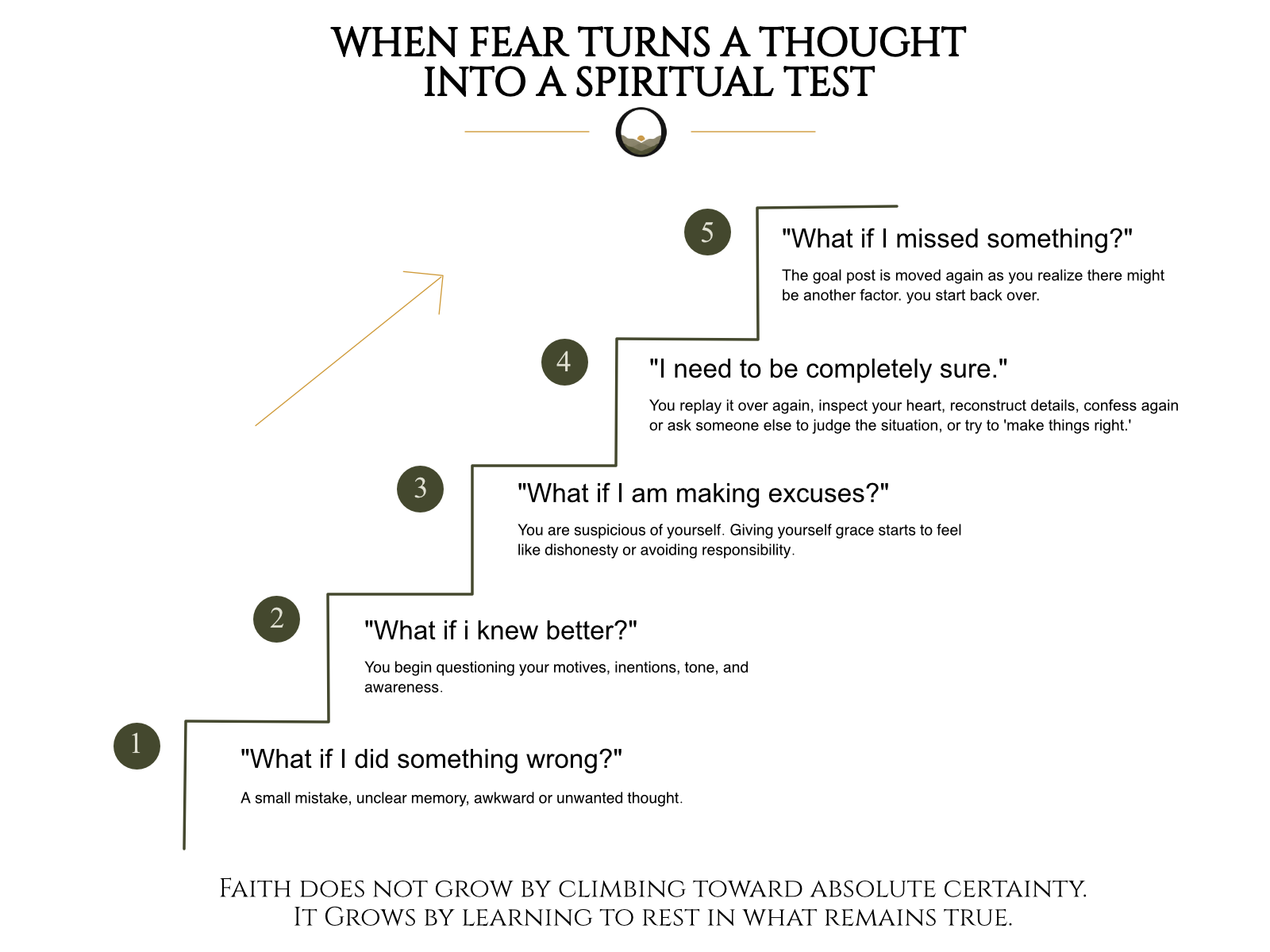
You begin to feel responsible not only for what you knowingly chose, but for every possible wrong you could have failed to notice.
You begin to investigate to reveal your hidden motives.
You go to the other person and begin to clarify, and then reclarify.
And when the subject is about sin, that growing introspection can feel righteous and good.
It can feel like integrity.
You might even find yourself asking questions like:
What if this lingering concern is not anxiety at all, but God warning me not to become hard-hearted?
And when the concern feels spiritual it can begin to demand enormous attention.
So the struggler begins to look longer, and then longer, and then often becomes consumed by the question.
The question may feel spiritual, but it is still worth noticing what the fear is asking you to do next.
The Things We Do to Feel Safe
Scrupulosity rarely remains an intellectual exercise.
Usually the questions lead to actions:
Asking someone for reassurance
Apologizing again or excessively
Confessing again
Researching whether something counts as a sin
Or it may remain internal:
Replaying a conversation
Reconstructing a memory
Assessing motives
Debating your sincerity
All of those responses are understandable because they each promise something that you feel you are missing.
By replaying memories you hope to get better clarity and certainity.
By asking someone for reassurance you hope to get outside judgment you can trust.
By confessing again you will feel like you did everything you could.
The responses you or others have may look different.
But underneath there is a shared belief: maybe this will allow me to feel safe enough to move on.
And sometimes it works.
For a while.
That relief matters because it can teach you something without you realizing it:
So the next time fear arrives, there is an urge to repeat the same response as before.
What relieved fear yesterday can become what fear demands tomorrow.
When Conscience and Anxiety Become Difficult to Separate
One of the hardest questions for someone with moral scrupulosity is:
“What if this really is my conscience?”
That question deserves care and gentleness.
The answer cannot be that conscience is irrelevant.
Scripture treats conscience as significant. It can accuse or defend. It can be shaped by truth. It can also be weak, misinformed, hardened, or defiled.
Conscience matters.
But an uneasy conscience is not the same thing as an infallible conscience.
And for someone struggling with scrupulosity guilt can be fuzzy, because if guilt remains then maybe there is something there.
It’s not usual for someone struggling to assume that the reason they are still wrestling is because God has refused to let the issue go.
This all creates a terrible burden.
In the Scriptures, 1 John 3:19-20 gives a very different framework.
In essence, it says that believers can “reassure” or “set at rest” their hearts before God, even when their hearts condemn them, because God is greater than the heart and knows everything.
John is not saying, “Your guilty feelings are always wrong,” nor is he saying, “Ignore your conscience.”
The idea is that our inward self-judgment is not. the final authority; God’s knowledge is fuller and more reliable than our own condemning heart.
John does not teach us to despise conscience. He teaches us not to treat our own condemning heart as omniscient. Our inward sense of guilt is real, but it is not final. God knows more fully than we do
The struggle may even go beyond that of conscience alone.
Another biblical counselor by the last name Emlett has written specifically about how Romans 14:23 can be misunderstood by someone with scrupulosity, illustrating how Scripture itself can become caught up in the anxious search for certainty when it is removed from the original context given.
When unwanted thoughts involve God Himself, that struggle can become even more confusing; Handling Blasphemous Thoughts and the Fear of Offending God looks at that problem more directly
It teases that one more self-examination might finally make you certain.
That if you think carefully enough you can fully understand your motives.
That if you confess thoroughly enough, that you can know nothing was left undone.
That if you argue with your conscience enough it will eventually have nothing left to say.
That if you do the mental rituals you will be safe.
That if you confess, read your bible, pray, fast, and do ‘good’ that you will get to where you want to be.
Those promises are what keep the struggle going.
But the certainty is always just beyond reach.
Scrupulosity offers safety on the condition you first eliminate uncertainty. That is why the need to feel certain before moving forward can be so strong.
That you gain full and complete knowledge of yourself and your motives in every situation.
What Scrupulosity Tries to Give
Over time scrupulosity can begin to reshape what you think a faithful Christian should look like.
You believe you can become mature enough to know if your repentance was genuine.
You will become always able to distinguish if a troubling thought reflected temptation, desire, or something else.
But scripture never promises that level of self-knowledge.
Being in Christ does not mean that every motive becomes infinitely transparent.
Neither does it say that every moral question comes with absolute certainty.
The trouble is that we sometimes have motives that are mixed.
Sometimes we have imperfect emotions.
We have hearts that we don’t understand exhaustively.
Sometimes scrupulosity can distort our understanding of sanctification by tying it to certainty and control.
That distortion matters.
It quietly changes the goal.
You are no longer simply trying to obey God in what he has made clear.
You are trying to obtain absolute certainty about yourself and your motives.
That is the big lie of scrupulosity and what it offers.
You are asking certainty to the offer you safety that only God can ultimately give.
Christianity does not place the weight of your standing before God on the quality of your self-assessment.
In the scriptures Romans 8 asks who can bring a charge against God's people when God is the one who justifies.
The Christian hope is not that you will eventually become skilled enough at examining yourself that no accusation can survive.
Your hope is Christ.
The Gospel Gives You Something Scrupulosity Cannot
You are saved by Christ.
That does not make holiness less important.
It puts holiness back into right view. ]
You strive for holiness because you belong to him.
Not because perfectness will give you safety.
Learning to Leave Some Questions Unfinished
Let’s acknowledge something.
This may be one of the harder aspects.
The feeling may still be there.
You may still want another answer.
You may still feel guilty.
You may still feel disgusted.
You may still be tempted to replay the conversation, to confess one more time, to ask someone one more time.
But you cannot live by what you feel.
There comes a time that you have to acknowledge something like this:
I have responded to what I can reasonably understand.
And I can entrust what I am unable to settle to God.
That is not moral carelessness.
Rather, it is refusing to let your hearts demand for certainty have control over your life.
It is decding to get back to faithfully doing what God has set in front of you.
Listening to the person across from you.
Finishing the work that is in front of you.
As Frodo moves toward Mordor, the Ring becomes heavier.
What once seemed capable of giving its bearer power increasingly reveals what it really does: it takes possession of the one who believes he can possess it.
That is one reason Tolkien's picture fits this struggle so well.
Moral scrupulosity may begin with something genuinely good.
To have a conscience that was clear.
To know that you were being honest.
To repent when you have sinned.
To live faithfully before God.
Then certainty begins to seem like the way to protect all of those things
So you look again.
You confess again.
You revisit the conversation.
You inspect the motive.
You seek another answer.
And somewhere along the way, the thing that promised to help you feel morally safe begins determining how much of your attention, time, and life it is allowed to take.
You Were Never Meant to Carry the Ring Forever
The answer is not to become careless about sin.
It is not to silence conscience or decide that holiness no longer matters.
The Ring was not dangerous because protecting Gondor was wrong. It was dangerous because the Ring could never safely become the means by which Gondor was saved.
In the same way, certainty is unable to bear the weight you have set on it.
Certainty easily becomes the thing you look to, instead of God, to bring you peace, safety, and security..
The gospel offers something different.
It allows you to repent where sin is clear without requiring you to solve every question about yourself.
It allows conscience to speak without making conscience omniscient.
It allows you to admit that some questions remain unfinished while trusting that God knows what you do not.
The unanswered question may still call after you.
But you do not have to carry it everywhere it asks to go.
You can keep walking.
That is where Getting Back to Life begins.
Author: Cody Shores, M.A.B.C., M.Div.
Resources
Anxiety and intrusive thoughts can raise difficult questions about faith, sin, conscience, and our relationship with God. These articles examine those concerns in light of Scripture, with particular attention to the difference between unwanted thoughts, genuine spiritual concerns, and the desire for certainty above everything.





What’s Next?
Chapter 5 : Getting back to life
Facing our fears is hard, but it doesn’t have to be done outside the grace & mercy of God. His Word offers to us truth and wisdom for understanding and engaging suffering, while granting us courage to do the hard things.