Chapter 3
Responding differently To Fear
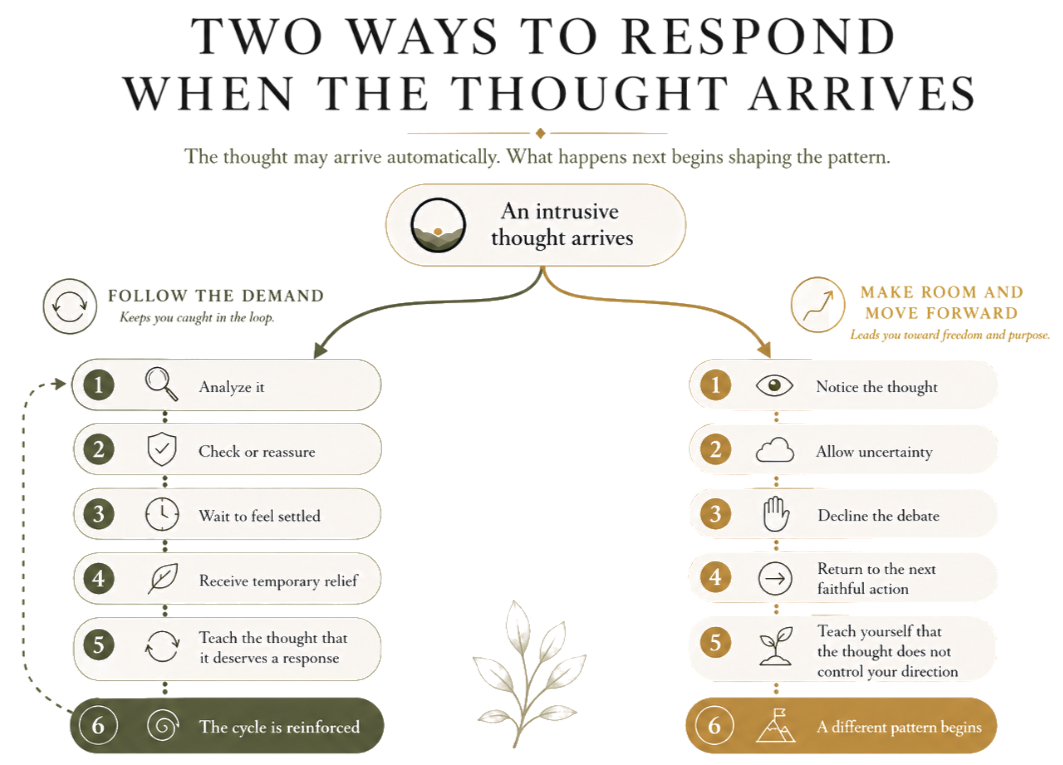
Different is never easy. The moment after the thought arrives, the urge to solve, neutralize, or escape it seems already decided. But your response can be anything but inevitable.

Does this feel familiar?
You know your usual response isn’t working, but doing nothing seems irresponsible.
You are afraid that if you don’t respond correctly the thought will get stronger.
You keep testing if the thought still bothers you.
You hope that this time the relief will last.
You want to respond differently but are unsure in the moment what that looks like.
Main Guide
Not Every Thought is an Assignment
A guide to responding when anxiety, intrusive thoughts, OCD, and fear return and immediately feel like something you have to answer.

You Know the Thought
You understand why it became important.
You may even recognize how easily the question can get reopened.
But here you are again.
You're making dinner. Working. Driving home. Reading something. Talking with someone you love.
And the thought arrives.
Maybe out of nowhere, or triggered by something familiar.
Almost immediately, it seems to hand you an assignment.
Go back over that.
Figure out what that meant.
Check how you feel.
Try to remember every detail.
Fight to gain certainty before you move forward.
The thought may have arrived in a fraction of a second, but suddenly it is trying to decide the next 20 minutes of your life.
That is where Responding Differently begins.
Not with learning how to prevent every unwanted thought from entering your mind. [Research on Thought Avoidance by Daniel Wegner]
But with learning that:
Let’s Imagine Something Together
Think about your phone, the one thing you take everywhere.
You’re driving, and it buzzes.
You hear it.
You know something has arrived.
Maybe it was a text. An email. An alert from something.
The notification is real.
The very loud and real notification does not get to grab the steering wheel.
Its arrival doesn’t automatically determine what you should do next.
You might read it later.
You could discover that it matters.
You might find out that it does not.
The distinction is simple.
Something arriving for your attention is not the same thing as something having authority over your attention.
The difficulty is that intrusive thoughts that trigger anxiety can blur that distinction.
A thought enters:
Did I say something wrong?
And almost immediately it becomes:
Go review the conversation.
You notice a sensation:
That feels strange.
And it becomes:
Check it again.
You remember something:
I can't recall that clearly.
And suddenly:
You need to reconstruct the event.
Notice something.
The thought did not merely bring content.
It brought an assignment.
That assignment may feel so natural that you barely notice yourself accepting it.
The thought asks.
You begin working.
The Hidden Verb Matters
See, we usually focus on what the thought says.
But sometimes it is useful to notice what the thought is asking you to do.
Remember
Review
Compare
Search
Ask
Rehearse
Neutralize
Make sure
That changes the question.
Instead of only asking:
“Why am I having this thought?”
You begin recognizing:
That does not mean you now need to analyze every thought to determine whether it deserves engagement.
That could quickly become another task.
The point is simpler.
A thought and a response are not the same event.
Something can occur in your mind without requiring you to immediately begin working on it. [Michael Twohig's Research on Responding Differently to Unwanted Thoughts]
Let’s Imagine Something Else Together
Imagine receiving an email marked URGENT while sitting with someone who needs you.
The word urgent may be in capital letters.
The sender may want an immediate response.
But the sender does not automatically have the authority to decide what matters the most in that moment.
You have to exercise judgment.
The same is true internally.
The loudest thought is not automatically the wisest voice.
The strongest feeling is not automatically your next responsibility.
And the existence of a question does not necessarily obligate you to produce an answer before returning to what you were doing
Who or What Directs Your Life?
Let’s imagine you are eating dinner with your family.
The old thought arrives again.
Maybe out of nowhere, or maybe something someone said triggered it.
The thought invites you inward.
You replay it.
You check it.
You try to solve it.
And if you are not careful, you can let it take over.
But there is already something in front of you.
Your wife is telling you about her day.
Food is getting cold.
Someone laughs about an inside joke you all share.
Someone else asks a question.
Responding differently often requires recognizing that the thought is not the only thing making a claim on the moment.
Love does too.
Sometimes work does.
Rest does at other times.
Worship does.
Friendship does.
The ordinary responsibilities God has already set around you do.
The question should not be:
“How do I make this thought go away?”
The thought may or may not go away quickly—something you have very little control over.
The more important shift is realizing:
The thought does not have to become the organizer of the moment.
Loud and Obnoxious
Winston Churchill once repeated an old saying about never reaching the end of a journey if you stop to throw a stone at every dog that barks.
Some things demand our attention, but that doesn’t mean that they should get it.
Consider Nehemiah in the Bible.
Nehemiah 6:3
“I am doing a great work and am unable to come down.”
The situation is obviously different from intrusive thoughts. Nehemiah was responding to actual instigators, not describing anxiety.
But the idea is worth noting.
A summons can be real without deserving your obedience.
Something can request your attention without having the right to redirect your work.
And faithfulness can sometimes look like staying where you have already been called to stand.
That matters because fear often behaves like a summons.
Come down from what you are doing.
Engage with this question.
Give this another ten minutes.
Stop the thing you are doing until this feels settled.
The demand can be repeated.
It can become louder.
It can even feel irresponsible to refuse it.
But repetition does not create authority.
Sometimes the faithful response is not another answer.
Sometimes it is:
There is already something God has given me to do here.
That does not mean every concern should be dismissed.
Wisdom still matters.
Real problems deserve real responses.
Repentance matters when repentance is actually called for.
Decisions deserve thought.
Bodies sometimes need medical attention.
Relationships sometimes require difficult conversations.
Responding differently is not learning to disregard reality.
It is learning that fear does not get to define reality merely by demanding your attention.
The Thought Can Remain While You Continue
This may be one of the hardest aspects.
You may decide not to reopen the question—and still feel the question.
You may return to dinner—and still hear it in the background.
You may get back to work—and still feel unsettled.
You may continue a conversation—and still want to retreat into your head.
It can be tempting to interpret that as evidence that the response did not work.
But that makes the thought going away the standard by which you judge whether or not you responded well.
There is no secret action that can just make a thought go away. [Ed Welch on Trusting God Even When Fear Remains — CCEF]
The goal of Responding Differently is not to give you a technique so the thought vanishes on cue.
You have likely already discovered that this is simply not how anxiety, intrusive thoughts, OCD, and fear work.
Rather, the goal is to learn that the thought does not have to dictate your response simply because it remains. [International OCD Foundation: Research-based OCD treatment]
There is a freedom in that distinction.
Who Gets to Set the Agenda?
You could:
- Research
- Investigate
- Seek reassurance
- Do a ritual
- Try to neutralize the thought
You could also:
- Finish the email
- Listen to your spouse
- Make dinner
- Return to work
- Pray because you want to talk to God—not because you want to neutralize a thought
- Rest when it’s time to rest
- Serve someone
A thought, fear, or anxious feeling enters your mind.
That is one event.
What you do next is another
WHERE THIS LEADS NEXT
→ Getting Back to Life
Learning to Respond Differently is key to getting back to ordinary responsibilities, relationships, and meaningful life.
→ Faith & Fear
When the thought involves God, sin, conscience, salvation, or spiritual fear, the struggle can become difficult in another wayt
Author: Cody Shores, M.A.B.C., M.Div.
Resources




Recognizing an unhelpful pattern is one thing; learning to respond differently is another. These articles consider the desire for certainty, the difficulty of trying to disengage with the thought, and what it means to move forward without resolving every ‘what if.’
What’s Next?
Chapter 4 : Faith , Fear & Religious Scrupulosity
You might say, “But I’m not religious.” Every action and response ultimately says something about our deepest values, where meaning is found, and what you live for.