Chapter 5
Getting Back to Life Beyond Anxiety
Learn how to return to relationships, responsibilities, and meaningful activities without having to wait for every thought, fear, or uncertainty to go away.

Does this feel familiar?
You feel your world shrinking.
Life has gradually gotten smaller as fear, uncertainty, and intrusive thoughts have begun setting your limits.
You avoid more and more things, locations, and activities.
You miss the freedom of enjoying ordinary things.
You want to get out of the spiral and have your circle begin to widen.
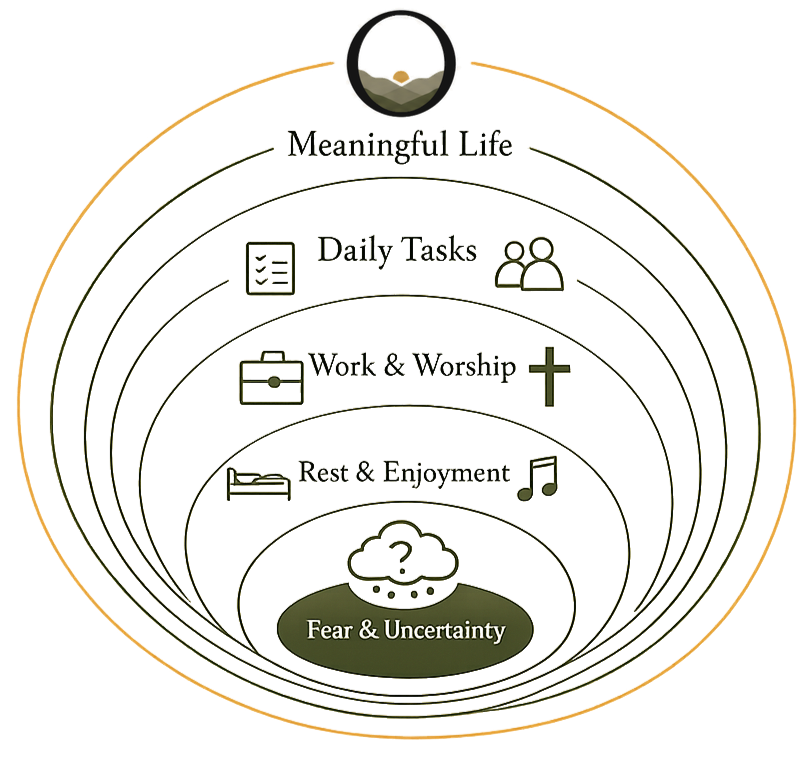
YOU CAN MOVE FORWARD BEFORE YOU FEEL READY
Main Guide
Getting Back To Life
A guide to receiving and participating in the life God has given you, even if anxiety, intrusive thoughts, or uncertainty have not fully gone away.

It has taken time.
Maybe a lot more than you would have ever guessed.
You avoided going somewhere.
You no longer called someone.
You slowly gave up something you enjoyed.
You became less spontaneous.
Some places became harder to go to.
Some conversations became easier to delay.
You got used to spending evenings physically with others while your attention was elsewhere—reviewing, solving, checking, trying to get your mind quiet enough to come back.
None of this usually occurs all at once.
There is a point in a long struggle with anxiety when you may begin to realize that the struggle has cost you more than anxious moments.
Usually, it is not one giant step that got you here, but a thousand little ones.
There is rarely a morning when someone announces:
Today I am going to shrink my entire life.
It occurs inch by inch.
One concession to fear makes sense.
Then another.
Then another.
And one day you look around and realize something difficult: Fear has received far more of your life than you ever intended to give it.
That deserves honesty.
But it is not the end of the story.
There are two things you may need to hear at the same time.
You cannot go back and live yesterday again.
And your life is not over.
Fear Rarely Takes Everything at Once
Fear usually negotiates.
Not today.
Wait until you feel better.
You can do that when this settles down.
Maybe next time.
Its requests can seem reasonable because they are usually small.
The difficulty is that fear rarely comes back later and says, “Thank you. That was enough.”
It learns.
Avoiding something uncomfortable can make avoidance look useful.
Waiting can make waiting seem wise.
Arranging your life around what feels safest can gradually make safety seem like the most important consideration in every decision.
And a life can begin to reorganize itself around fear without ever deliberately choosing fear as its center.
That is part of what makes getting back to life difficult.
You are not merely restarting activities.
You may be learning to live according to a different organizing question.
Not: What arrangement of my life will keep me from feeling anxious?
But: What is worth receiving, doing, loving, and participating in—even if anxiety comes with me?
There May Be Something to Grieve
Sometimes Christian encouragement moves too quickly.
Often we try to immediately get to hope.
But there may be something worth grieving first.
Maybe you genuinely lost time.
The constant anxiety, fear, and rituals may have affected your marriage.
Your family remembers a season of you being there but not really being there.
Maybe you turned down jobs or career advancement that will not return.
Some have spent years trying to solve a question that still doesn’t have the certainty you hoped for.
Maybe who you were before the struggle seems very far away.
There is no wisdom in acting like those things do not matter.
And there is no spiritual maturity in rushing past grief with a quick encouragement.
Ecclesiastes, a book in the Bible, is far more honest than that.
Time moves.
Generations come and go.
Seasons end.
Things are lost.
Life is brief.
You do not get to go back and live yesterday again.
That is a hard truth.
But it is not the same thing as saying nothing good remains.
Grief says: Something mattered, and I wish it had been different.
Hopelessness says: Because I cannot recover what had been lost, nothing worthwhile remains.
Scripture gives us no reason to make that second conclusion.
You Do Not Need Your Old Life Back
When people say, “I just want my life back,” I understand what they mean.
They usually mean:
I want to feel free again.
I want to stop thinking about this all the time.
I want to enjoy things the way I used to.
There is something deeply human in that desire.
But perhaps getting back to life does not mean reconstructing the exact life you remember.
You have grown and changed.
So have those around you.
So have the circumstances that surround your life now.
Trying to recreate some earlier version of yourself isn’t likely or realistic.
Maybe the better question is not:
How do I become exactly who I was before this?
Maybe it’s:
That is a very different question.
It allows grief without making the past your only definition of a good future.
You may not get yesterday back.
But today has not yet been lived.
That you gain full and complete knowledge of yourself and your motives in every situation.
Ecclesiastes is surprisingly hopeful for a book that talks so much about death, uncertainty, frustration, and vapor.
The Teacher refuses to flatter us.
He offers no trite solutions.
Ecclesiastes and the Life You Cannot Secure
He repeatedly reminds you that:
You don’t have control over time.
You cannot guarantee your plans will succeed.
You are unable to fully understand what God is doing in your life.
You are unable to extend your life.
And you certainly are not able to make it safe.
That sounds bleak until you realize what Ecclesiastes does with those limits.
It does not tell you to become cynical.
It does not tell you that nothing matters.
And it does not tell you to spend your life trying to overcome the limitations of being human.
Instead, again and again, it turns your attention toward the life God has actually given you.
Eat your food.
Do your work.
Love the people God has placed near you.
Receive what is good.
Enjoy what can be enjoyed.
Fear God.
Live before him.
That is very different from saying, Life may be miserable, so try to enjoy it anyway.
Ecclesiastes is saying that the meaning of your life was never dependent on your ability to control it.
The meal before you matters because it’s a gift from God.
The work matters because it is part of the life he has placed in your hands.
The people around you matter because loving them is part of what faithfulness looks like.
The ordinary moments of life become places where you can live as a creature before your Creator—gratefully, humbly, courageously, and for his glory.
That fundamentally alters the question.
Anxiety keeps asking, what if:
This goes wrong?
I can’t handle it?
I never feel the way I want to feel?
This does not get easier?
Ecclesiastes does not suggest you will be given enough information to eliminate every one of those questions.
Instead, it points toward another way to live.
Even if I am unable to control what comes next, I can still live this day before God.
Even if fear comes with me, I can love the person in front of me.
Even if I do not feel ready, I can do the work I have been given.
Even if this season is harder than I would have chosen, I can still grow in patience, courage, gratitude, service, and love.
Even if I cannot make my life safe, I can still live it for the glory of God.
It means suffering does not get to determine the entire meaning of your life.
The goal is not merely to find moments of enjoyment in an uncontrollable world.
The goal is to live faithfully in the world God has given you—to receive his gifts, love your neighbor, do the work before you, and become more like Christ in the middle of a life you cannot fully manage.
Anxiety says:
Secure life first. Then you can live it.
Ecclesiastes points somewhere deeper:
You were never meant to secure your life before living it. You were meant to receive it from God and live it before him.
One of anxiety’s strange effects is that it can make ordinary life seem insignificant.
Meals.
Work.
Friends.
Rest.
Church.
Laughter.
Helping someone.
Sitting outside.
Fixing something.
Listening.
But Scripture often places enormous value on ordinary life.
God gives daily bread.
He gives work.
He gives people to love.
He gives rest.
He gives worship of something worthy.
He gives fellowship for the isolated.
He gives small acts of service.
These things do not matter because they successfully reduce your anxiety.
They matter because they are part of the life God has given you.
That is a significant distinction.
If you go for a walk only because you hope it will make you feel better, what occurs when you come home still anxious?
Was the walk wasted?
If you meet a friend and the intrusive thought stays with you, was the conversation a failure?
If you worship and do not leave feeling peaceful, did worship not work?
Of course not.
Ordinary life does not have to justify itself by making you feel better.
A friend is worth seeing because the friend matters.
Worship is worthwhile because God is worthy.
Work can be meaningful because it serves someone.
Getting back to life means allowing things outside your struggle to matter again for reasons of their own.
Ordinary Things Are More Significant Than They Look
We tend to imagine courage as a feeling.
Confidence.
Resolve.
The absence of hesitation.
But real courage often looks—well, far less courageous.
It feels nervous.
It would prefer to wait.
It has doubts.
And it moves anyway.
Real Courage Usually Looks Less Dramatic Than We Imagine
Getting in the car.
Going to work.
Staying for dinner.
Going to a church service.
Taking the vacation.
It is deciding that something else matters enough that fear does not get the final vote.
There are goods greater than feeling completely safe.
God’s glory is one.
Love.
Faithfulness.
Service.
Joy.
Responsibility.
You do not have to feel courageous to decide to be courageous.
The moments will look a lot less like the film Braveheart starring Mel Gibson, and a lot more like The Secret Life of Walter Mitty starring Ben Stiller.
For Those Looking for a Guarantee
Every time will not go easy.
Everything will not be a straight line.
Everyday will not be two steps forward.
There will be days old thoughts return.
Something you thought was getting easier, may get hard again.
You may avoid something you wish you had faced.
You may wake up discouraged by how familiar the struggle feels.
All of which can be especially frustrating after you feel like you’ve moved forward.
It’s easy to think, “I thought I was done with this?”
But one day or one week of struggle doesn’t erase the work you have been doing.
Some days will be failures.
Some days will be successes.
Everyday must be an effort to set one foot in front of the other, and aim trust in Christ and faithful living.
This is where Ecclesiastes brings us back.
You do not control the length of your life.
You do not control the outcomes.
You cannot make the world safe enough to remove every reason for fear.
That is not bad news.
In fact, it shows something anxiety has been trying to hide from you: you were never meant to carry the weight of securing your own life.
You are a creature, not the Creator.
Your task is not to know everything God knows, control everything he controls, or guarantee what only he can guarantee.
You task is to live the life he has given to you for the Glory of God.
To fear—God alone.
To love those around you.
To do the good works he has gifted you for.
To repent of sin when you fail.
To trust Christ when you are weak.
And, over time, to become more like him in the middle of an ordinary life you never fully control.
That is why getting back to life is about more than becoming less anxious.
If the ultimate goal were simply to feel better, then every difficult moment would threaten your existence and joy.
But our hope is larger than that.
Because even if the road remains harder than you hoped, it is still a road on which you can know God, love others, glorify Christ, and become more like him.
Ecclesiastes tells the truth about life under the sun: it is brief, uncertain, and beyond our control.
The gospel tells us something Ecclesiastes itself points us toward but cannot fully unfold: the God before whom you and I live has come near in Christ.
So you don’t have to squeeze enough certainty out of life before you can begin living.
You don’t have to recover who you used to be.
You are liberated from short-sighted goal of getting back to normal.
You have been given the grace to do the hard thing and trusting that God will ultimately deliver.
That he doesn’t abandon.
That he doesn’t every let down.
That he is worthy of trust.
Jesus Christ frees us to live before God without first making our lives safe, predictable, or emotionally settled.
He is our security.
He is our hope.
He is our future.
Author: Cody Shores, M.A.B.C., M.Div.
Resources
When fear and uncertainty begin to shape our decisions, ordinary responsibilities and relationships can gradually take a back seat. These articles consider what meaningful change looks like, how to respond to setbacks, and how to reengage daily life even when anxiety is not fully gone.





What’s Next?
Chapter 6 : For Loved Ones
Learn how to encourage someone with compassion and steadiness without entering into their reassurance seeking, avoidance, or checking patterns that keep them stuck.